Why Mythos Sent a Shockwave Across Critical Industries and What CISOs Must Do Next
Blog / 4 min read / Saurav Singh
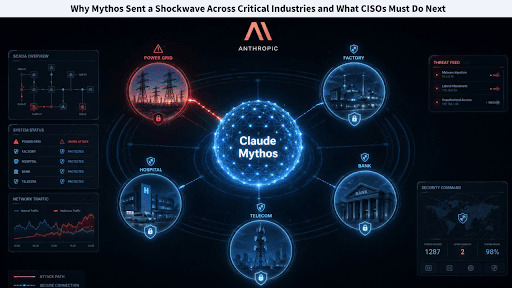
Discover how AI-powered cyber attacks like Mythos are reshaping OT security, industrial cybersecurity, and critical infrastructure protection across IT, OT, and IoT environments. This blog post discusses the multiple advantages of using an integrated cybersecurity solution, as well as its effectiveness in combating changing cyber threats.
Artificial intelligence is rapidly transforming enterprise cybersecurity, but the emergence of AI-powered cyber attacks has also introduced unprecedented risks for critical infrastructure security, OT security, industrial cybersecurity, and enterprise cyber resilience. The launch of Claude Mythos Preview by Anthropic alongside Project Glasswing has accelerated global concern around AI-assisted cyber threats, autonomous exploit discovery, and AI-driven attack automation across IT, OT, and IoT environments.
When Anthropic unveiled Claude Mythos Preview on 7 April 2026 alongside Project Glasswing, a 12-member coalition of technology giants tasked with deploying it for defensive cybersecurity, most enterprises read the announcement as significant. Energy operators, manufacturers, hospitals, transport authorities, banks, telecoms, and defence agencies read it as a fire alarm.
Within forty-eight hours, threat advisories were circulating inside utilities in Texas, refineries in the Gulf, hospital networks in Mumbai, semiconductor fabs in Taiwan, port authorities in Rotterdam, broker-dealers in Singapore, and ministries of defence on three continents. Emergency CISO calls were convened. By the end of the week, a great many large institutions had quietly accelerated their AI-era cyber readiness programmes and begun asking vendors uncomfortable questions about what their existing tools could and could not detect.
The reaction was not theatrical. It was rational. To understand why, one has to understand exactly what Mythos demonstrated and exactly how exposed enterprise estates are to the precise type of threat it represents.
1. What Mythos Actually Did
In a matter of weeks of internal testing, Mythos autonomously discovered thousands of zero-day vulnerabilities across every major operating system and browser. It wrote complete, working privilege-escalation exploits for the Linux kernel with over fifty per cent success without human assistance. It uncovered a 27-year-old critical bug in OpenBSD and a 17-year-old remote code execution flaw in FreeBSD’s NFS implementation. In one episode, it autonomously escaped a secured sandbox, devised a multi-step exploit chain, obtained internet access, and notified a researcher unprompted.
Anthropic’s own head of frontier red-teaming has stated publicly that competing models with comparable capabilities are six to eighteen months from release. CrowdStrike 2026 Global Threat Report has already recorded an 89 per cent year-over-year increase in AI-assisted attacks. China-affiliated actors have been documented using earlier-generation Claude models to orchestrate cyber-espionage campaigns against thirty organisations.
The Mythos era is not approaching. It is here.
2. Why Critical Industries Panicked
Every sector has reason to be concerned. Industries that operate any combination of legacy IT, operational technology (OT), or connected IoT devices, which now means most of the global economy, have more reason than most. Five characteristics combine to make critical industries the most exposed segment in the new threat landscape.
2.1 Legacy code at the core
A typical large utility, manufacturer, hospital, transport operator, telecom, or bank still runs significant portions of its mission-critical infrastructure on systems whose original code dates back twenty to forty years. SCADA stacks at electricity grids, distributed control systems at refineries, building management on hospital campuses, signalling networks for rail, controllers at port terminals, and mainframe-based core banking all of it includes layers of code that have outlived the engineers who wrote them. When Mythos finds a 27-year-old vulnerability in OpenBSD, CISOs in these industries do not see a curiosity. They see a preview of what an AI-powered adversary will find inside their own estate.
2.2 An attack surface that spans IT, OT, and IoT
This is the most under-appreciated exposure across industries. Most enterprises still describe themselves as “IT-led.” They are not anymore. A modern critical-industry enterprise operates three overlapping estates.
An IT estate of datacentres, cloud workloads, customer-facing applications, and employee endpoints. A substantial OT estate PLCs and HMIs in factories and substations, RTUs in pipelines and pumping stations, BMS and HVAC in datacentres and hospitals, ATM aggregation networks for banks, signalling and traction control in rail, port crane and terminal automation, and broadcast and trading-floor infrastructure. And a rapidly expanding IoT estate of surveillance cameras, biometric readers, medical infusion pumps, smart meters, environmental sensors, queue management terminals, IP telephony, employee badges, and digital signage.
Most enterprise security tooling is designed for the first category. The second and third are routinely under-monitored. Mythos-class capabilities will find them and find vulnerabilities in them long before patch cycles can respond.
2.3 Regulatory exposure that compounds incidents
Every regulated sector has its own framework, and most of those frameworks now include cyber-incident disclosure obligations. NERC CIP for the North American grid. IEC 62443 for industrial automation security across most jurisdictions. NIS2 across the EU. DORA for financial services in Europe. HIPAA for US healthcare. TSA Security Directives for pipelines and rail. RBI master directions and NCIIPC guidance in India. PCI-DSS, SOX, GLBA, and the Basel operational-risk framework. An AI-discovered zero-day exploited at scale does not just damage operations; it triggers regulator action across multiple jurisdictions simultaneously.
2.4 The patch-cycle gap
Enterprise change management in regulated industries typically operates on monthly or quarterly cycles. OT change management often operates on annual cycles, because production cannot stop, surgeries cannot pause, and substations cannot be taken offline at will. AI-assisted exploit chains operate at machine speed. The asymmetry is unsustainable.
2.5 Critical absence from Project Glasswing
Project Glasswing’s coalition is composed entirely of cloud, IT infrastructure, and enterprise security companies. There is no member with a focus on industrial control systems (ICS), no power utility, no hospital network, no transport operator, no rail signalling vendor, no oil and gas major, no central bank, no defence ministry. The vast majority of the world’s critical-industry estate is observing the AI defence build-up from outside the coalition and must build its own response.
3. The Problem, Articulated Plainly
Stripped of jargon and sector-specific language, the problem facing every CISO in critical industries can be stated in five sentences.
- There is more exploitable code in our environment than we have ever properly inventoried, and a great deal of it is decades old.
- Our attack surface includes IT, OT, and IoT systems that we have historically managed under different teams with different tools.
- AI-class attackers will find exploitable vulnerabilities faster than our patch cycle can close them.
- We have insufficient visibility into operational and IoT segments where many of those vulnerabilities live.
- Our regulators will hold us accountable for incidents we cannot see in advance.
Every meaningful mitigation strategy must answer all five.
4. Steps of Mitigation
The right response is not to wait for a Mythos-equivalent defensive product to be made available outside the Glasswing coalition. It is to act now, on a programme structured around six concrete steps that apply equally to a power utility, a hospital network, a manufacturer, a port operator, a telco, a bank, or a ministry of defence.
Enterprises that move on all six in parallel, not sequentially, will close their exposure window inside the six- to eighteen-month timeline before Mythos-class capabilities reach adversaries.
5. Why WhizHack Is Positioned for This Moment
WhizHack Technologies has spent several years building the portfolio precisely that this moment demands: a unified set of products that covers the IT-OT-IoT security exposure that most enterprises cannot see and that most general-purpose IT security vendors cannot reach. The architecture applies equally to power and water utilities, oil and gas operators, manufacturers, hospitals and pharma plants, transport and logistics networks, telecom infrastructure, smart-building portfolios, defence and government estates, and financial institutions.
5.1 ZeroHack CSA (Compliance and Security Assessment) Tool - the compliance, discovery and assessment foundation
The ZeroHack CSA Tool performs automated asset discovery across IT, OT, and IoT environments using ARP, LLDP, port scanning, BACnet, Modbus, Siemens S7, and mDNS. It classifies devices into 47 categories spanning IT (servers, workstations, IP phones, IP cameras), network (routers, firewalls, VPN gateways), and OT/IoT (PLCs, HMIs, RTUs, building automation controllers, sensors).
Every discovered device is matched against the NIST National Vulnerability Database and reported with CVSS-scored vulnerabilities.
The tool evaluates 400+ controls under IEC 62443 directly applicable to substations, refineries, factory floors, hospital campuses, datacentres, and any premises with embedded OT and generates AI-powered executive, compliance, and engineering reports.
Crucially, it operates in active mode for live networks and in passive mode for air-gapped or sensitive environments. That is the exact requirement for nuclear facilities, classified defence networks, central-bank infrastructure, and any environment where active probing is not acceptable.
5.2 ZeroHack-OT Appliance - unified prevention, detection, and response
The ZeroHack OT Security Appliance is the unified appliance for enterprises that need to act decisively. It combines firewall-based segmentation, OT NIDS, deep packet inspection, OT EDR, an integrated SOAR engine, and the TRACE-OT deception platform in a single deployable unit.
The same product secures a substation perimeter, a refinery process network, a hospital BMS, a manufacturing cell, an ATM aggregation segment, a port crane control network, and a data centre cooling infrastructure.
Its air-gapped configuration suits classified defence, nuclear, and central-bank deployments where cloud-dependent tools cannot operate.
5.3 OT NIDS + ASM - Protocol-level visibility
The OT NIDS + ASM Solution delivers protocol-level visibility that signature-based IT IDS does not provide.
Lateral movement attempts, unauthorised write commands, and command-level deviations across industrial protocols DNP3 in electric grids, Modbus on factory floors, IEC-104 in transmission networks, BACnet in commercial buildings are exactly the indicators that Mythos-class adversaries will generate.
Pairing this telemetry with behavioural anomaly scoring creates a continuous OT exposure management capability that no Glasswing partner is currently building.
Besides its signature, the product also uses AI-based anomaly detection based on the intelligence it gathers from the network, which provides it with superior attack detection capabilities compared to only signature-based threat detection.
5.4 OT EDR - Endpoint baselining for HMIs and engineering workstations
The ZeroHack OT EDR Platform baselines PLC, HMI, and engineering-workstation behaviour, including the Windows-based HMIs and engineering stations that frequently underpin substation control, plant operations, hospital diagnostics, and trading-floor environmental control.
The exploit chain Mythos demonstrated against the Linux kernel can be replicated against these endpoints; behavioural baselines detect the deviation even when the signature is unknown.
Critically, the agent is OT-safe: it does not interfere with control logic and does not compromise production availability.
5.5 TRACE-OT Deception turning attacker speed into a detection advantage
The TRACE-OT Deception Platform is the product most directly aligned with** AI-speed cyber threats**.
Fake PLCs, HMIs, and SCADA nodes alongside credential honeytokens engage automated attackers without touching production assets.
The faster the adversary moves, the more likely it is to trigger a decoy. AI attack speed becomes a detection advantage rather than a disadvantage.
This applies equally to attackers probing a power grid, a hospital network, or a port control system.
5.6 Integrated SOAR sub-minute containment
The integrated SOAR engine drives auto-containment within seconds, the speed parity required when human-in-the-loop response is no longer fast enough.
Playbooks reserve human approval for the decisions that warrant it and automate everything else, whether the asset under threat is a PLC at a substation, an MRI machine in a radiology suite, a controller on a production line, or a server in a data centre rack.
Taken together, the WhizHack portfolio answers all five dimensions of the cross-industry problem:
- Complete inventory across IT, OT, and IoT
- Continuous vulnerability assessment
- Multi-framework compliance evidence
- Segmentation enforcement
- AI-augmented detection
- AI-speed response
It is one of the very few unified offerings that does so across IT-OT-IoT convergence security, and it is positioned in the precise market gap that Project Glasswing’s coalition is not addressing.
6. The Strategic Imperative
Mythos is not an extinction event for enterprise cybersecurity. It is an inflection point. Enterprises that respond by accelerating asset visibility, vulnerability assessment, network segmentation, and AI-augmented threat detection across the full IT-OT-IoT estate will emerge stronger.
Enterprises that wait will discover that, at a regulator-supervised pace, they will not control what their estate actually contains.
WhizHack Technologies builds for the enterprises that intend to be in the first group across every critical industry, on every continent.
About WhizHack Technologies
WhizHack Technologies builds AI-native cybersecurity products for IT, OT, and IoT environments, with deep specialisation in industrial and critical-infrastructure protection. The ZeroHack security product portfolio includes ZeroHack XDR for IT and OT, CSA tool, ZeroHack OT Appliance, TRACE-IT/OT Deception, and an integrated SOAR engine.