Ransomware attacks are no longer isolated incidents affecting only large enterprises. This blog post discusses the multiple advantages of using an integrated cybersecurity solution, as well as its effectiveness in combating changing cyber threats.
Why Ransomware Simulations Are No Longer Optional
When organisations think about cybersecurity, they often focus on deploying the “best” technologies:
- Stronger firewalls
- Advanced threat detection
- SIEM solutions
- AI-powered monitoring tools
But cybersecurity is far more complex than relying on solutions.
Most ransomware attacks do not occur because one security control fails.
They happen when multiple small weaknesses across systems, processes, applications, and human behaviour align at the same time.
For example:
- A phishing email bypasses filtering
- An employee clicks a malicious attachment
- An endpoint misses suspicious activity
- A security alert is ignored or delayed
- Network segmentation is incomplete
- Backups are not properly validated
Individually, these may appear to be manageable gaps.
Together, they create a path for attackers.
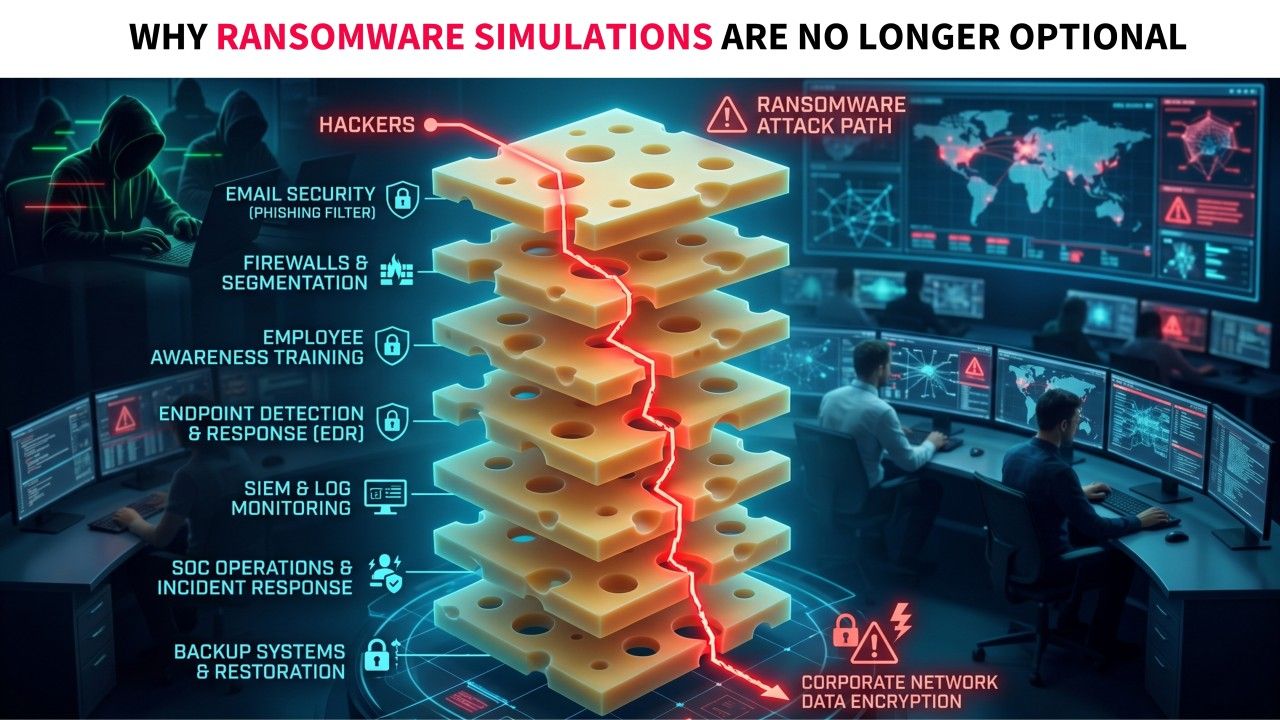
This is exactly what the Swiss Cheese Model of Cybersecurity Risk Management explains.
What Is the Swiss Cheese Model?
The Swiss Cheese Model is a widely recognised risk management framework that explains how failures and security incidents occur when multiple weaknesses align simultaneously.
Originally developed by psychologist James Reason, the model has been widely applied across:
- Aviation
- Healthcare
- Manufacturing
- Critical Infrastructure
- Cybersecurity
to understand how threats bypass multiple layers of protection.
Imagine several slices of Swiss cheese placed side by side.
Each slice represents a security control, such as:
- Firewalls
- Antivirus solutions
- Employee security awareness training
- Access controls
- Security monitoring systems
- Endpoint protection platforms
The holes in each slice represent vulnerabilities or weaknesses.
These gaps may exist because of:
- Human error
- Misconfigurations
- Process failures
- Technical limitations
- Delayed responses
- Incomplete visibility
Normally, one defensive layer can stop a threat even if another layer fails.
However, when weaknesses across multiple layers align, attackers can bypass every defense and successfully compromise the organisation.
This is exactly how modern ransomware attacks often succeed.
How the Swiss Cheese Model Explains Ransomware Attacks
Consider a typical ransomware attack path:
- A phishing email bypasses email security
- An employee clicks the malicious link
- Endpoint protection fails to detect malware
- Security alerts are missed or ignored
- Backups are outdated or inaccessible
Each issue alone may seem minor.
Together, they create the perfect attack path.
The Swiss Cheese Model reminds organizations that cybersecurity is not about building one perfect defense.
It is about creating multiple security layers that work together to reduce risk and improve resilience.
The Swiss Cheese Model in Modern Cybersecurity
Think of your organization’s security architecture as multiple slices of Swiss cheese stacked together.
Each slice represents a defensive layer such as:
Email Security
Firewalls
Endpoint Detection & Response (EDR)
##### Security Information and Event Management (SIEM)
OT Network Monitoring
Security Operations Centre (SOC)
Incident Response Teams
Every layer reduces risk.
But every layer also has limitations.
- No firewall blocks every attack
- No employee identifies every phishing attempt
- No SOC analyst investigates every alert immediately
- No endpoint solution detects 100% of threats
Attackers understand this very well.
Modern ransomware groups are:
- Highly organized
- Patient
- Strategic
- Financially motivated
They carefully:
- Study environments
- Identify weak points
- Move laterally across networks
- Disable security controls
- Target backup systems
- Launch encryption attacks
The challenge is not a lack of security tools.
The challenge is that many organisations assume their security controls are working effectively together without ever validating them under realistic attack conditions.
That is where Ransomware Simulation becomes critical.
Why Traditional Security Testing Is No Longer Enough
Many organisations still rely heavily on:
- Compliance audits
- Vulnerability assessments
- Penetration testing
- Security policy reviews
- Continuous SOC monitoring
While these are valuable security activities, they do not answer the most important question:
"How would our organisation actually respond during a real ransomware attack?"
A real ransomware incident introduces:
- Operational pressure
- Communication challenges
- Cross-functional coordination issues
- Business disruption
- Time-sensitive decision making
Traditional assessments rarely measure these factors.
Ransomware Simulation Exercises bridge this gap by safely recreating realistic attack scenarios within controlled environments.
These exercises test not only technology—but also people, processes, and response capabilities.
What a Ransomware Simulation Actually Reveals
One of the most valuable outcomes of a ransomware simulation exercise is discovering hidden security gaps before attackers do.
A simulation may reveal:
- Security alerts being missed or delayed
- Weak escalation procedures
- Insufficient log visibility
- Poor backup validation practices
- Incomplete network segmentation
- Weak coordination between IT and OT teams
- Gaps in incident response playbooks
Many organizations discover that the issue is not the absence of security tools.
The issue is:
- Lack of integration
- Lack of visibility
- Lack of preparedness
This is why realistic Attack Simulation and Security Validation exercises are so effective.
They expose reality.
Final Thoughts
Ransomware attacks are no longer isolated incidents affecting only large enterprises.
Every organisation connected to digital infrastructure is a potential target.
Attackers are becoming:
- Faster
- Smarter
- More automated
- More organized
Defensive strategies must evolve accordingly.
The Swiss Cheese Model reminds us that cybersecurity is not about perfection.
It is about resilience.
Organizations that continuously:
- Test
- Validate
- Measure
- Improve
their defenses are far better positioned to withstand modern cyber threats.
Ransomware Simulation Exercises provide a realistic understanding of how people, processes, and technologies perform together under pressure.
Because in cybersecurity, preparedness is not defined by what exists on paper.
It is defined by how effectively an organization responds when an attack happens.
Strengthen Your Cyber Resilience with ZeroHack-S
To help organisations proactively evaluate their readiness against modern ransomware and Advanced Persistent Threat (APT) attacks, WhizHack Technologies offers:
ZeroHack-S – Next-Generation APT-Based Attack Simulation
ZeroHack-S is designed to safely simulate sophisticated ransomware and cyberattack scenarios within controlled environments, helping organisations assess:
- Security control effectiveness
- Detection capabilities
- Incident response readiness
- Cyber resilience maturity
- Operational preparedness
Key Highlights of ZeroHack-S
Simulates Real-World Ransomware Attack Scenarios
Validates organisational readiness against realistic cyber threats.
Tests Existing Security Controls
Including:
- IDS
- IPS
- Antivirus solutions
- Firewalls
- Email security gateways
- Endpoint protection platforms
Evaluates Incident Response Readiness
Measures how effectively teams respond under realistic attack conditions.
Provides Actionable Security Insights
Delivers recommendations to strengthen cybersecurity posture and reduce organizational risk.
With ransomware incidents increasing globally and attackers increasingly adopting double-extortion tactics, organizations must move beyond traditional assessments and actively validate their readiness against modern threats.