The Power of Cyber Range (What Universities are Missing)
Blog / 4 min read / Saurav Singh
The global cybersecurity skills gap is significant and growing, with a projected need for more than 4 million cybersecurity professionals to fill existing roles by 2025. This blog post discusses the multiple advantages of using an integrated cybersecurity solution, as well as its effectiveness in combating changing cyber threats.
Hi readers,
Let’s start with a simple comparison.
Would you ever trust a surgeon who has never set foot in an operating room?
Or
A pilot who has never practised in a flight simulator?
Of course not.
(Yet in cybersecurity education, we continue to train students as if theory alone will prepare them for real-world attacks.)
The global cybersecurity skills gap is significant and growing, with a projected need for more than 4 million cybersecurity professionals to fill existing roles by 2025. However, very few universities have incorporated advanced Cyber Range platforms in their pedagogy, a critical instrument in producing market-ready cybersecurity graduates.
According to Gartner, by 2022, 15% of large enterprises will use cyber ranges to develop their security teams' skills, up from less than 1% previously.
This striking increase highlights a growing recognition of hands-on cybersecurity training that many universities have yet to embrace.
The Reality We Can’t Ignore
Almost every day, we read about another major breach.
- Banks crippled by ransomware
- Hospitals forced to shut down by malware
- Even the national infrastructure is disrupted by hackers
And the costs are staggering — cybercrime is expected to cost the world over $10 trillion a year by 2025.
ring - cybercrime is expected to cost the world over $10 trillion a year by 2025.

India’s education sector faced nearly 8,500 cyberattacks per week over the past six months — making universities one of the most targeted industries.
And credential theft, the fastest-growing attack type, has surged 160% globally this year, with India among the hardest-hit markets.

With over 75 billion connected devices expected by 2025, the attack surface is expanding rapidly, resulting in high-profile attacks like WannaCry and millions of cyberattacks blocked quarterly.
India faces a significant cybersecurity talent shortage, with many cybersecurity roles remaining unfilled.
Cybersecurity upskilling not only ensures career growth but also strengthens the defence against evolving cyber risks in a digital-dependent world.

87% of executives view digital skills shortages as a major barrier to digital transformation.
By 2027, 75% of organisations may face disruptions due to this gap.
Cybersecurity threats have surged 38% year-over-year, with a global shortage of 3.4 million cybersecurity professionals.
IT burnout is widespread, with 56% of IT staff experiencing high stress.
Skill shortages also slow AI adoption, with 50% of businesses citing it as a key barrier.
By 2025, half of the employees will need reskilling.
Why Classrooms Alone Aren’t Enough
To be clear, universities do a great job of teaching the fundamentals:
- Network topologies
- Encryption
- Compliance frameworks
All of this matters.
But here’s the problem:
Attackers don’t follow textbooks.
When ransomware is spreading or a phishing campaign compromises accounts, the question isn’t how well you can write an exam answer.
The real skill is:
- Can you spot the attack in time?
- Can you respond effectively under pressure?
- Can you recover before real damage is done?
That kind of skill isn’t built in lectures.
It only comes from real-world cybersecurity practice.
The Growing Importance of Cyber Range Training
A Cyber Range provides a controlled, realistic environment where learners can experience live cyberattacks, security incidents, and defence operations without affecting production systems.
Unlike traditional classroom instruction, cybersecurity simulation training enables students and professionals to:
- Practice incident response
- Investigate cyberattacks
- Detect threats in real time
- Improve cyber defence strategies
- Develop hands-on technical skills
This practical experience bridges the gap between academic learning and industry requirements.
Made-in-India: WhizRange by WhizHack
While many universities hesitate to adopt Cyber Range solutions due to cost, complexity, or lack of trained faculty, homegrown solutions are beginning to change the game.
One such solution is the WhizRange Cyber Range Platform by WhizHack Technologies, a Made-in-India Cyber Range platform designed to bring hands-on cybersecurity training to classrooms and professional programs.
What makes WhizRange significant is that it:
- Offers a cost-effective and scalable model tailored to Indian institutions
- Simulates real-world attack scenarios—from ransomware outbreaks to IoT and cloud vulnerabilities
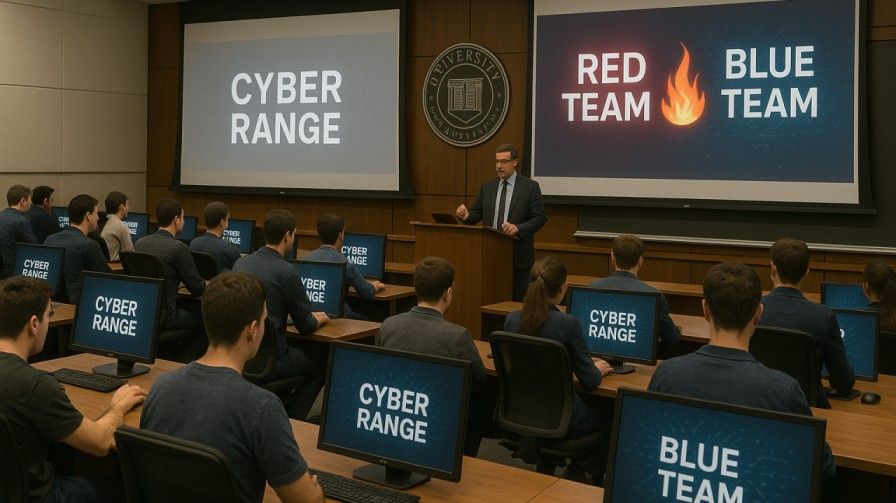
- Supports Red Team vs Blue Team exercises, allowing participants to experience both offensive and defensive cybersecurity operations
- Integrates industry-standard cybersecurity tools so learners practice with technologies used in real-world security environments
Instead of depending on imported systems, WhizRange demonstrates that India can build its own world-class cybersecurity training platforms, aligning with the country’s broader vision of digital self-reliance.
Building Industry-Ready Cybersecurity Professionals
Organisations today are looking for professionals who can do more than explain cybersecurity concepts.
They need professionals who can:
- Detect threats
- Analyze attacks
- Respond to incidents
- Recover critical systems
- Protect enterprise infrastructure
This is why cybersecurity workforce development increasingly depends on immersive training environments rather than theory-only learning.
Platforms such as:
Are helping bridge the gap between education and real-world cybersecurity operations.
Final Thoughts
Cybercrime is escalating.
The cybersecurity skills gap is widening.
And higher education can no longer afford to rely on theory alone.
Cyber ranges are not an optional add-on.
They are the missing piece of modern cybersecurity education.
Platforms like WhizRange by WhizHack show us what’s possible:
Turning students into defenders, not just degree holders.
Tools, simulations, Red Team vs Blue Team exercises, and real-world attack scenarios are what transform learners into professionals ready for today’s cybersecurity challenges.
Let’s Start the Conversation
Now, we’d love to hear from you:
- Do you think universities are doing enough to prepare students for real-world cyber threats?
- Should Cyber Range training become mandatory in cybersecurity programs?
- If you’re an educator or student, what would it take to make hands-on cybersecurity training part of your curriculum?